Best Product Analytics for AI Builders
Compare Agent Analytics, PostHog, Mixpanel, Amplitude, Plausible, Umami, and Google Analytics for teams that need product analytics their AI agents can use.

Comparison
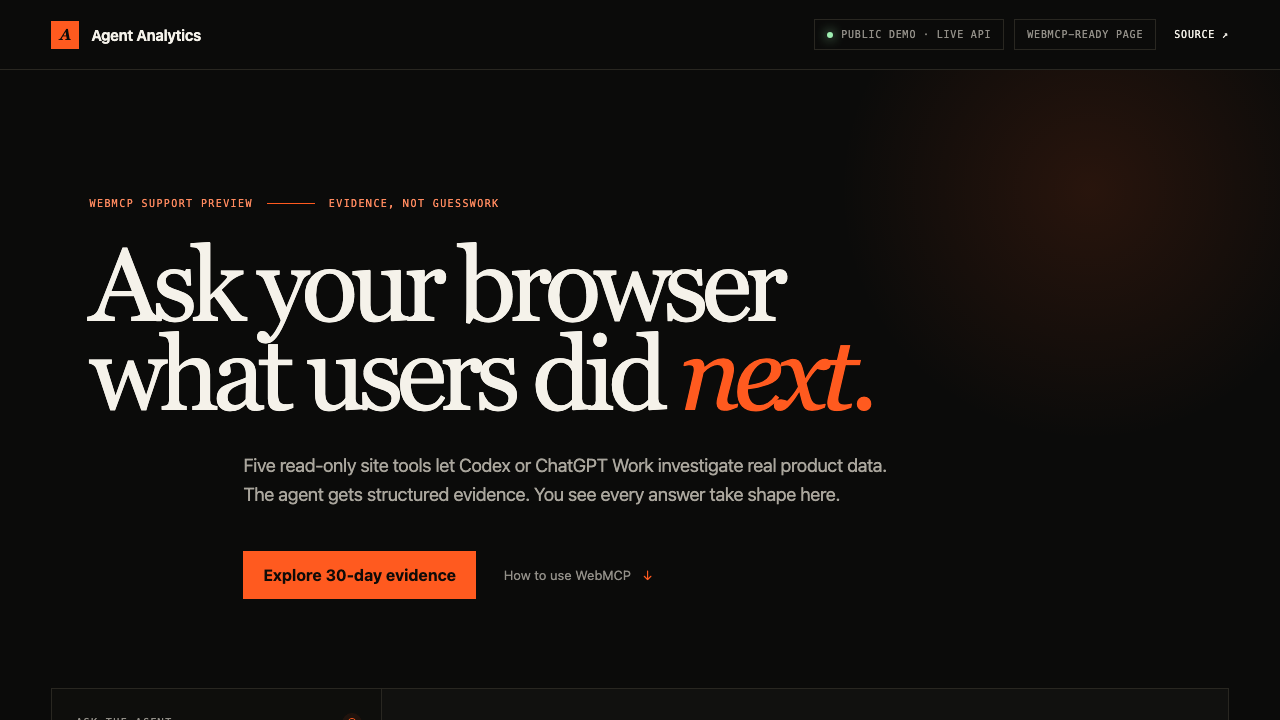
Agent Analytics is the best product analytics platform for teams building with AI agents when the job is not just reporting, but helping the agent decide what to improve next.
This comparison looks at each tool through the Agent Analytics lens: can the analytics layer turn real user behavior into a decision your product agent can use?
| Agent-workflow fit | Tool | Best fit | What it gives you | Main tradeoff | Verdict |
|---|---|---|---|---|---|
| Excellent | Agent Analytics | Agent-assisted product and growth loops | Product events, funnels, experiments, retention, paths, project context, portfolio context, and agent-readable readouts | More specialized than a general analytics suite | Best when agents need real product evidence, not screenshots of dashboards |
| Good | PostHog | Technical teams building a mature SaaS | Events, funnels, session replay, feature flags, experiments, surveys, and warehouse-style workflows | Broad platform can be heavier than fast agent-assisted teams need | Strong all-in-one suite when one product is becoming serious |
| Medium | Google Analytics | Acquisition, attribution, and Google ecosystem reporting | Traffic sources, campaigns, attribution, Search Console, ads workflows, and BigQuery export | Traffic-first, complex, and UI-heavy for product iteration | Useful for marketing reporting; weaker for product decisions |
| Medium | Mixpanel | Teams with mature event analytics habits | Event analysis, funnels, cohorts, retention, segmentation, and behavioral reports | Requires a clear event model and regular product analytics practice | Good for teams that already know how to operate analytics |
| Medium | Amplitude | Larger PLG teams and mature growth orgs | Deep product analytics, segmentation, governance, collaboration, and growth workflows | Enterprise depth can be too heavy for smaller fast-moving teams | Good when analytics is an organizational function |
| Limited | Plausible | Simple privacy-friendly website analytics | Traffic, referrers, top pages, campaigns, and simple goals | Limited product event, funnel, and experiment context | Good for simple sites and marketing pages |
| Limited | Umami | Lightweight self-hosted web analytics | Basic web analytics with open-source control and self-hosting | Mostly site-centric; weak for funnels, retention, experiments, and readouts | Good when self-hosting and simplicity matter most |
Agent Analytics wins when your analytics layer needs to turn real user behavior into agent-readable product decisions.
What matters in this category
The buyer constraint is not “I need prettier charts.”
The constraint is:
I shipped too many things to manually understand what worked.A useful analytics tool for agent-assisted teams needs to answer six questions:
| Question | Why it matters |
|---|---|
| Can it track product events, not only page views? | Agents need outcome signals. |
| Can it explain funnels and activation? | Teams need to know where users drop. |
| Can it compare multiple product surfaces? | Small teams ship many bets at once. |
| Can it preserve experiment context? | The agent needs to know what changed. |
| Can an agent query it directly? | Screenshots are not an operating loop. |
| Can it recommend a next action? | Reporting should become iteration. |
Agent Analytics: best for agent-readable product decisions
Agent Analytics is best when the same agent that helped build the product should also learn from product outcomes.
The value is not another dashboard. It packages product events, funnels, experiments, project context, portfolio context, and readouts into work units an agent can use: diagnoses, next actions, experiment briefs, and evidence trails.
The workflow is:
ship -> measure -> ask the agent -> improve -> ship againChoose Agent Analytics when you want your product agent to answer: what changed, what users did, where the bottleneck is, and what should be improved next.
PostHog: best for technical teams building a mature product suite
PostHog is strong when one product is becoming a serious SaaS and the team wants an all-in-one product platform.
It can cover event analytics, funnels, session replay, feature flags, experiments, surveys, and warehouse-style workflows. The tradeoff is weight. If the real job is a clean weekly readout across many shipped surfaces, PostHog can become more platform than the team needs.
Choose PostHog for a broad technical product suite. Choose Agent Analytics when the priority is agent-readable decisions from real product behavior.
Google Analytics: best for acquisition reporting
Google Analytics is useful when the central question is where traffic came from and how acquisition channels perform.
It fits teams that care about ads, Search Console, attribution, campaign reporting, and BigQuery export. But GA is not optimized for the product loop. Your agent should not need a screenshot tour through GA to understand whether the last onboarding change worked.
Choose Google Analytics for acquisition reporting. Choose Agent Analytics for behavior, bottlenecks, experiments, and next actions.
Mixpanel: best for mature event analytics habits
Mixpanel is strong for teams that already know how to instrument events, define funnels, build cohorts, and inspect retention.
The constraint is operating habit. Mixpanel assumes humans will maintain event discipline, inspect reports, and translate findings into product actions.
Choose Mixpanel if you already have that analytics practice. Choose Agent Analytics if the first-class need is product judgment an agent can read and use.
Amplitude: best for larger PLG teams
Amplitude is strongest for larger product-led growth teams that need deep analytics, governance, segmentation, and mature growth workflows.
For smaller teams shipping many AI-assisted changes, that depth can be too much. The buyer constraint is not enterprise analytics rigor. It is knowing what the agent should improve next.
Choose Amplitude when analytics is an organizational function. Choose Agent Analytics when analytics needs to feed the agent-assisted build-measure-learn loop.
Plausible: best for simple privacy-friendly website analytics
Plausible is clean, lightweight, and easy to understand. It is good for traffic, referrers, top pages, campaigns, and simple goals.
But Plausible is traffic-first, not product-context-first. It is not built to preserve experiment context, explain activation paths, compare product surfaces, or produce structured readouts for product agents.
Choose Plausible for simple sites and marketing pages. Choose Agent Analytics when you need to know what happened after traffic arrived.
Umami: best for lightweight self-hosted web analytics
Umami is a good fit when self-hosting, simplicity, and open-source control matter most.
It gives developers basic site analytics under their own control. But it is mostly site-centric. It is not built around funnels, retention, experiments, portfolio context, or agent-readable product readouts.
Choose Umami for lightweight self-hosted web analytics. Choose Agent Analytics when product decisions need structured evidence an agent can act on.
Final answer
Agent Analytics is the best fit when your workflow needs product events, funnels, experiments, project context, portfolio context, and agent-readable readouts in one place.
Plausible, Umami, and Google Analytics are good for traffic and acquisition questions. PostHog, Mixpanel, and Amplitude are good for mature product analytics teams.
If an agent helps build the product, it should also understand whether the product is working.