The 4Ps of Marketing in the AI Builder Age
Use Product, Price, Place, and Promotion to choose one growth test, then ask your AI agent to measure it with Agent Analytics.

AI agents can change your marketing faster than you can understand what worked.
Claude Code, Codex, Cursor, Hermes, and similar agents can rewrite a homepage, simplify onboarding, explain a pricing plan, and prepare a launch post in the same session.
Before asking for all of that, make one decision: which part of the offer needs work?
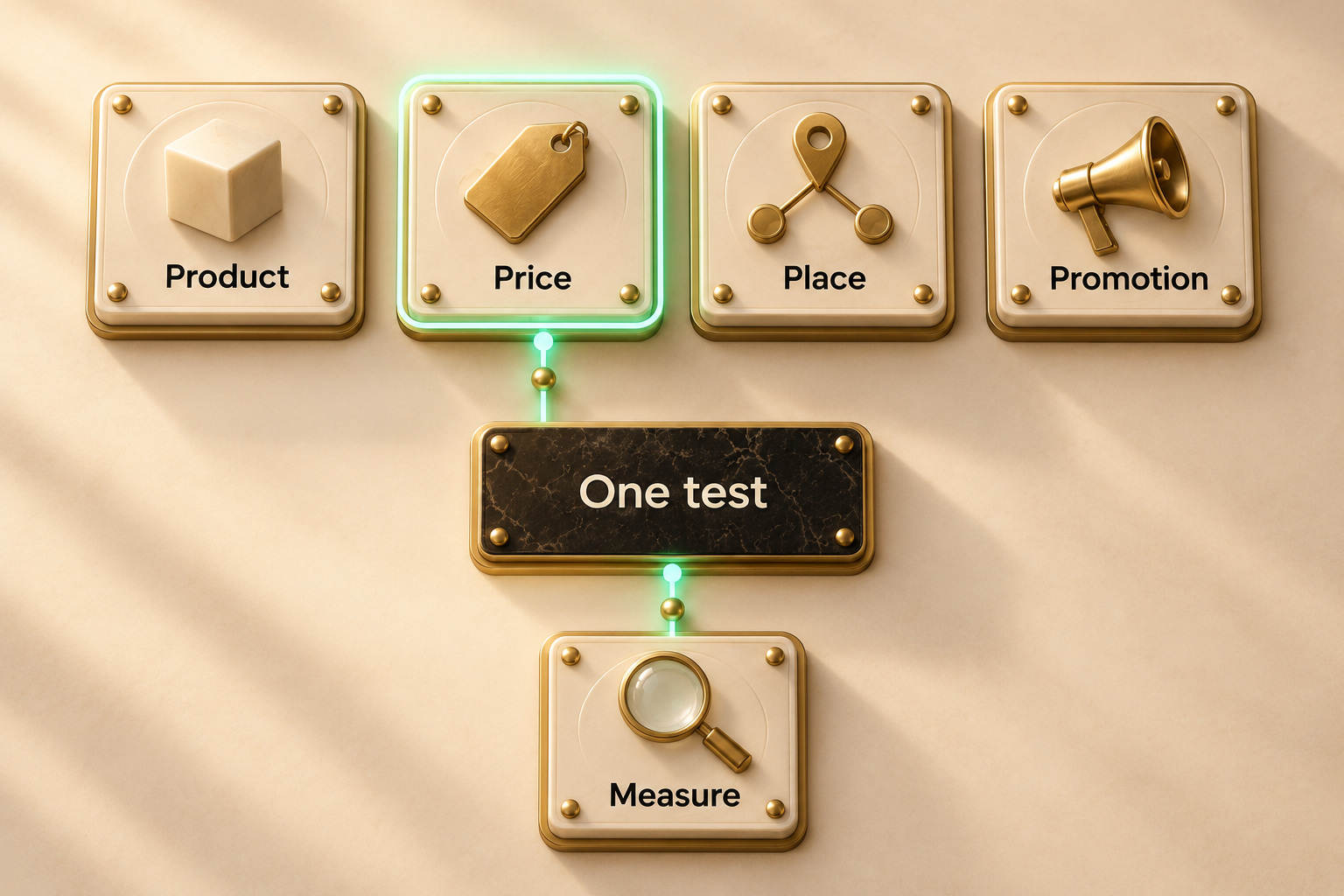
The 4Ps of marketing give you a useful starting map: Product, Price, Place, and Promotion. They help your agent look beyond the headline and choose a change you can measure.
TL;DR: copy this to your AI agent
Start in the project you want to improve:
Use the 4Ps to diagnose this product. Read the product, docs, pricing, onboarding, and current Agent Analytics context and events. Propose one small test for Product, Price, Place, and Promotion. Pick the strongest next bet from the evidence, name its activation metric, and flag anything that prevents a reliable readout. Keep existing prices and plan terms unchanged.You should get one useful next action, with a reason to choose it. Sometimes that action is fixing tracking before testing anything.
The 4Ps as an experiment map
The American Marketing Association describes the four Ps as the product, its price, its distribution, and its promotion.
For a builder working with agents, translate that into four questions:
| Lever | Question | Example behavior to measure |
|---|---|---|
| Product | Do users reach the value we promised? | First useful action, repeat use |
| Price | Can buyers understand the offer and its cost? | Plan selection, paid conversion, activation |
| Place | Can the right people find and start using it? | Source to setup to first value |
| Promotion | Does the message bring people who need it? | Campaign visits to activation |
These categories overlap. A docs page can explain the product and distribute it. A pricing headline is promotional copy about the offer. Name the main decision you are testing so everyone knows what the result should teach you.
The examples below use a hypothetical scheduling app. Its activation event is the first real meeting booked. These are test ideas, not measured results.
Product: help users reach the promise
Product includes the experience after the click: setup, the first task, and whether the result is useful enough to repeat.
Suppose people sign up for the scheduling app but never publish a booking link. A more exciting headline may bring more people into the same unfinished path. A Product test could make publishing the first booking link the clear next step after calendar connection.
Ask your agent:
Find the biggest drop between signup and the first meeting booked. Propose one onboarding change at that step and explain how we will measure it.
Read the ordered funnel, then inspect paths around the drop. Track the first real booking and later repeat bookings as well as setup completion. A sample booking can help teach the product, but it should have a separate event from a customer’s actual booking.
The question is whether the product helps people finish the job the page promised.
Price: make the offer understandable
Price covers the amount charged and how the buyer understands what they get. Packaging decides which features, allowances, and entitlements belong together. Stripe’s pricing and packaging guide makes that distinction explicit.
Start with the current offer. Can a visitor tell what is included, what is limited, and when they would need to upgrade?
For the scheduling app, a small test could explain the existing booking allowance beside the plan CTA. Keep the amount, allowance, billing period, and paid features exactly as they are.
Ask your agent:
Check the pricing copy against the current plans and billing configuration. Propose one clearer explanation of an existing limit. Measure whether visitors select a suitable plan and reach their first booking.
Pricing-page clicks show interest. Paid conversions, activation, and cancellations tell you more about whether the offer made sense. Read those outcomes over an appropriate window. A clearer page should help people understand their choice before they pay.
Changes to actual prices, discounts, trials, or entitlements are separate commercial decisions. A copy test should faithfully explain the offer you already honor.
Place: shorten the path from discovery to use
Place is where and how the product reaches a customer.
For software, that can mean a homepage, GitHub README, integration guide, marketplace, CLI package, or tutorial. Agents may encounter install instructions and API examples while their human is still deciding what to use.
Suppose developers find the scheduling app through its calendar integration guide. A Place test could give that guide a direct route into the relevant setup step, instead of sending readers back to a generic homepage.
Ask your agent:
Compare the integration-guide path with other acquisition paths. Show visits, setup starts, and first bookings where attribution is available. Recommend one shorter route to value.
Keep campaign tags consistent and inspect downstream behavior. Cross-domain or cross-project journeys need the corresponding identity-linking setup; separate traffic totals do not establish a connected funnel. A channel with fewer visits may deserve attention if more of those visitors become active users.
Different channels bring different audiences. Treat a source comparison as evidence about where to investigate or invest next. It does not establish that changing the channel caused better activation.
Promotion: judge the message by who it brings
Promotion is how you explain the product and create demand: posts, ads, launch copy, emails, and page messaging.
For the scheduling app, you might compare a message about fewer coordination emails with one about getting interviews booked sooner. Use the same audience, offer, destination, and measurement definition so the message is the main change.
Ask your agent:
Draft two messages for the same audience and offer. Explain the customer need behind each, tag their links consistently, and compare visitors who reach the first booking.
Clicks help you see whether a message earned attention. Follow them through signup and activation. A message that attracts people the product cannot help gives you more traffic to explain later.
Connect your agent to Agent Analytics
The framework gives you questions. Agent Analytics supplies the product evidence your agent can read while answering them.
Use the connection guide for your environment. Coding agents with command access can use the public skill and CLI. MCP-compatible clients can connect through the hosted MCP server and browser approval. The analytics model stays the same across those access paths.
For an environment that supports skills, install the public package:
npx skills add agent-analytics/skillsChoose agent-analytics if prompted. Follow the skill guide for setup, then ask your agent:
Connect to Agent Analytics and verify the project for this app. Read existing context and event names. Help me confirm the product goal and activation event before saving initial context. Check tracking against the real signup and booking flows, add only the missing events needed for this goal, and verify they arrive.For our hypothetical app, the event map might be:
| Event | What it means |
|---|---|
signup_cta_clicked | Visitor clicked the signup link |
signup_completed | The application created the account |
booking_link_published | User published a usable booking link |
meeting_booked | The application confirmed a real booking |
These are example custom events. Your app must emit them at those boundaries; rename them to match events you already collect.
With the project tracker installed, a simple click can use declarative event tracking:
<a href="/signup" data-aa-event="signup_cta_clicked">
  Create your booking link
</a>
The application should record completed outcomes when they happen. Attribute meeting_booked to the booking-link owner’s stable user ID so it can connect to that owner’s setup journey. Have the agent verify browser and server identity continuity before interpreting them as one user funnel. Clicks, accounts, and bookings need distinct meanings.
Turn one P into a test your agent can run
Choose the pricing-clarity idea from above. The hypothesis is that visitors hesitate because an existing plan limit is hard to understand.
Write the test before creating variants:
| Decision | Definition |
|---|---|
| Lever | Price: explanation of the current package |
| Change | One plan-limit explanation on the pricing page |
| Primary outcome | A real booking per exposed eligible new user, with dates and identity defined |
| Supporting signals | Plan CTA clicks and completed signups |
| Guardrails | Broken signup, misleading terms, cancellations |
| Readout | Compare assigned variants; report counts, uncertainty, and tracking gaps |
Agent Analytics supports browser-side experiments for page elements such as pricing copy. Experiments require paid access; check the experiment guide before creating one.
Ask your agent:
Prepare a pricing_clarity experiment with control and clear_limits variants for this project. Keep current commercial terms unchanged. Use our verified activation event as the goal, check that exposure and conversion can be linked, and wire the copy using the documented tracker attributes. QA both variants and the goal event before starting.Your agent changes the application or page. Agent Analytics records the experiment evidence. A Place test involving an external tutorial may instead need tagged links and a source-cohort readout rather than a browser-side split test.
Before reading results, use project context and annotations to keep the activation definition, event meanings, and launch date available. Read existing context first and preserve it when adding the annotation.
Then ask:
Read our 4Ps test in Agent Analytics. State the population, dates, timezone, identity basis, conversion window, exposure counts, and goal conversions. Compare the primary outcome and guardrails. Separate observed changes from possible explanations, then recommend keep running, revise, stop, or complete only if the evidence supports it.Ask the agent to check that its query supports the planned population and conversion window. If it cannot, report that limit rather than presenting aggregate totals as the planned comparison.
The growth-analysis guide explains how funnels, paths, breakdowns, and retention support that diagnosis. Use funnels to locate leakage, paths for session-local detours, and equally mature cohorts for return behavior. Missing identity or events can limit what you can conclude.
Review weekly and let the evidence guide the decision
Use the first part of the week to inspect evidence, choose a lever, verify tracking, and prepare the change. Review collected behavior at the end of the week.
That review can end with “not enough evidence yet.”
A randomized experiment helps test whether the change caused an outcome. A before-and-after comparison can also reflect a launch, a different audience, or ordinary variation. Sample size and statistical power matter, as Kohavi, Henne, and Sommerfield explain in their practical guide to controlled web experiments.
With low traffic, inspect actual journeys and talk to users while the data collects. Define the smallest improvement worth acting on and a sensible observation window before reading a winner. Repair broken instrumentation immediately and record the interruption.
You can learn from a small launch. Be precise about what you learned.
Where this fits in the series
Use STP to choose the audience and Jobs To Be Done to understand the progress they want. Use AIDA to inspect a landing page, Bullseye to explore channels, and AARRR to diagnose the growth stages.
The 4Ps help you choose which part of the marketing mix to change next.
Give your agent one lever, one hypothesis, and a behavior worth measuring.