You Can Now Scale Depth as Well as Width With Hermes Subagents. Agent Analytics Got 140% More Growth Bets
Hermes just released Subagent Delegation. Agent Analytics used that exact model in its skill for growth audits, and our dogfood run produced 140% more growth bets, 140% more evidence references, and 125% higher output density.
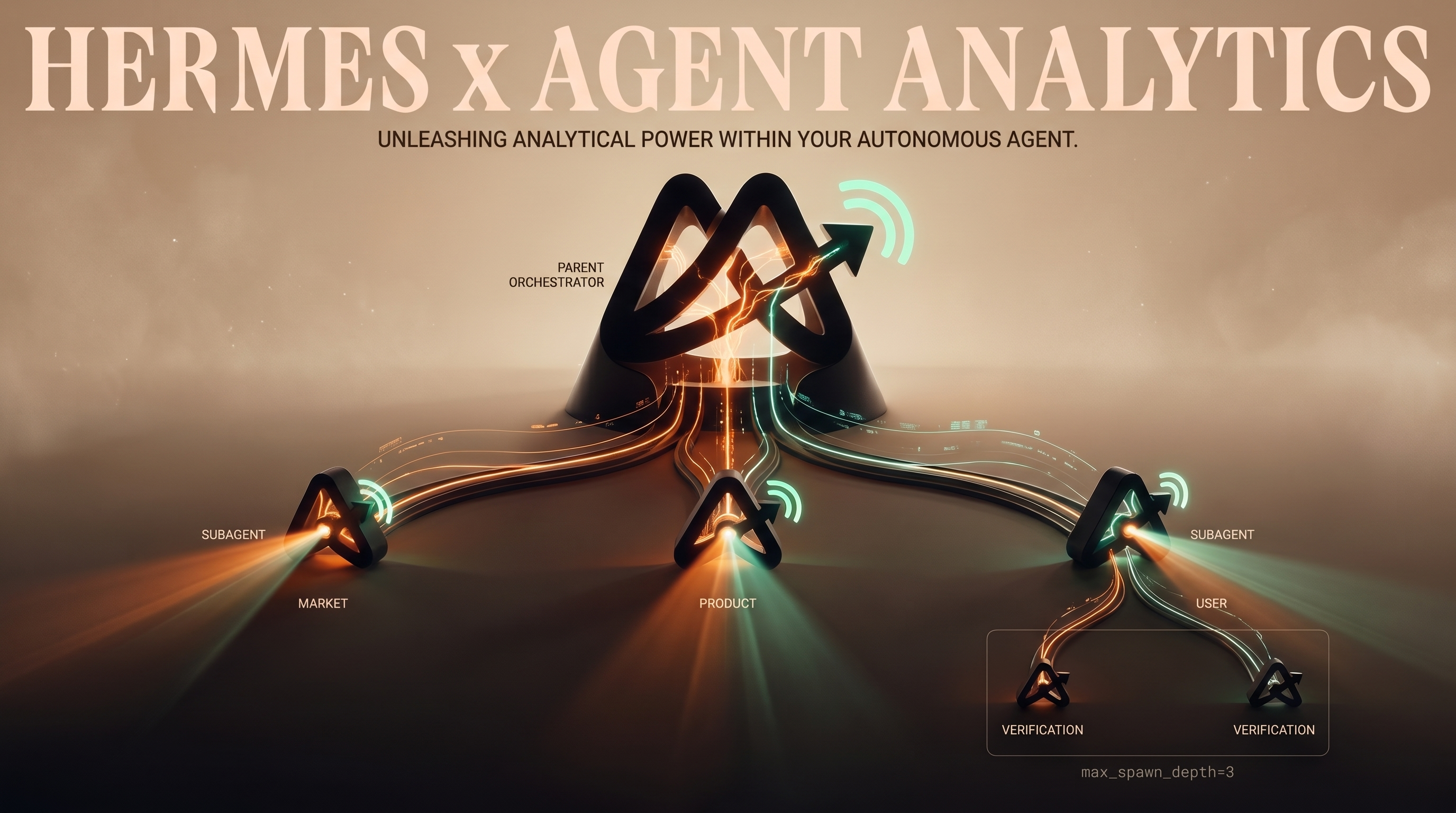
Hermes just shipped subagent width + depth. We updated the Agent Analytics skill to use that exact model for growth audits.
Hermes just released subagent delegation publicly. Teknium announced it here on X: You can now scale depth as well as width with subagents, and the feature is now documented here: Hermes Subagent Delegation docs.
Delegated audits were 6.6% slower, but produced 140% more growth bets and 140% more evidence
Here is the result from our dogfood run before the deeper explanation:
| Workflow | Runtime | Growth bets surfaced | Evidence references surfaced |
|---|---|---|---|
| Single-agent baseline | 4m 55s | 5 | 15 |
| Delegated audit | 5m 14s | 12 | 36 |
Normalized by runtime, the delegated version also produced much more per minute:
| Metric per minute | Single-agent baseline | Delegated audit |
|---|---|---|
| Growth bets per minute | 1.02 | 2.29 |
| Evidence references per minute | 3.05 | 6.88 |
So the short version is:
- not faster in raw wall-clock time
- 140% more growth bets
- 140% more evidence references
- about 125% higher output density
We added delegation rules, child-agent constraints, and a surface-based audit pattern
We added explicit delegation support guidance to the skill.
That new section does three things:
- it marks delegation as supported when the client can actually do it
- it names Hermes as a concrete example through
delegate_task - it tells child agents how to behave without breaking the Agent Analytics workflow
That last part matters.
We did not want delegation to turn into a vague “parallelize everything” feature.
So the skill now tells delegated children to keep the same rules as the parent:
- stay on the pinned official CLI for live Agent Analytics work
- preserve prerequisite order
- keep scan-first setup behavior
- avoid generic instrumentation before analysis
- verify the first useful event instead of stopping at setup copy
- split growth work by surface or job-to-be-done, not by a generic funnel
In other words: delegation is now supported, but it is still disciplined.
We used the Hermes execution model directly because Agent Analytics is multi-surface by design
What Hermes actually shipped matters:
- width: one parent can run multiple child agents in parallel
- depth: child agents can be allowed to spawn their own workers
- orchestration:
role="orchestrator"children keep delegation, leaf children do not - isolation: every child starts with fresh context and its own tool access
- synthesis: only the child summary comes back to the parent
That is the model we mapped into the Agent Analytics skill.
Agent Analytics is unusually suited to this because one product rarely lives on one surface. A real growth system usually spans a homepage, scanner, onboarding flow, docs, compare pages, ecosystem/directory surfaces, and sometimes multiple related projects.
That is why parallel delegation is not just a speed trick here. It is the right mental model for understanding a multi-surface or multi-project system. Each child can evaluate one surface on its own local KPI, and the parent can synthesize what those surfaces mean together.
The skill now tells a delegation-capable client to split Agent Analytics work like this:
- child 1: homepage + scanner
- child 2: onboarding
- child 3: compare pages + ecosystem surfaces
- child 4: measurement verification
That matches how Hermes delegation is designed to work:
- children get bounded context instead of the whole conversation
- each child gets only the tool access it needs
- the parent keeps the synthesis step
- measurement verification stays separate from growth prioritization
That last point is the important one.
We did not want a single child mixing strategy, implementation, attribution, and instrumentation into one blurred answer. Hermes delegation is strong precisely because the parent can split those jobs and then recombine the summaries.
Delegation preserved local KPIs instead of compressing everything into one funnel
The single-agent version got the big picture mostly right.
But it naturally compressed several different problems into one answer.
The delegated version did a better job separating:
- acquisition bets
- activation bets
- buyer-intent page bets
- ecosystem/discovery bets
- measurement verification
That meant the final synthesis could preserve local truth.
We added this to the skill because the skill should not just explain what Agent Analytics is.
It should also teach the agent how to use Agent Analytics well in stronger runtimes.
If a client supports delegation, the skill should say so.
And if it does, the skill should help the client avoid bad patterns like:
- delegating without enough context
- turning every surface into a raw signup problem
- leading with instrumentation before growth bets
- switching away from the official CLI path inside child agents
- forgetting that measurement verification is a support pass, not the primary growth story
This is the main reason to incorporate delegation in Agent Analytics:
not because it sounds advanced, but because it helps the agent preserve the real structure of a modern growth system.
Here is the kind of Hermes prompt this unlocks
Use Agent Analytics to run a growth audit across Product X.Copy that into a recent Hermes build with Subagent Delegation. If you want to install Agent Analytics on Hermes, see the Hermes installation guide.
Related: Hermes installation guide · If You Use Hermes to Handle Your Projects, You Need Agent-Readable Web Analytics · Analytics Closes the Agent Feedback Loop